Turning a Viral Saree Video Into a Detailed AI Video Prompt

A 45-second reel surfaces in the feed: a woman in a pastel chiffon saree turns toward golden-hour light, the pallu catches the breeze, and the clip vanishes into the endless scroll. The scene lingers. The reader wants that exact visual recreated in an AI video tool, but a vague prompt like “woman in Indian saree, cinematic” returns flat, generic output that shares almost nothing with the original.
The gap between a fleeting visual memory and a machine-readable description is the real problem. A single curated clip packs thousands of frames of information — fabric behavior, light direction, camera distance, environmental context — while a written memory retains maybe a dozen fragments. This article walks through the frame-level details that matter and a repeatable workflow for turning any saree clip into a structured prompt that actually reproduces the scene.
Why a Good Saree Scene Is Hard to Reproduce From Memory
Nobody watches a clip frame by frame. A 45-second reel compresses roughly 1,000+ frames and dozens of micro-transitions into a prompt that rarely exceeds 200 words. By the time someone sits down to write that prompt, the memory has already collapsed into a handful of impressions: the color of the saree, the setting, the general mood. Everything else — the specific way the pallu lifted, the direction of the wind, the architecture behind the subject — is gone.
Generic descriptions like “woman in saree, cinematic lighting” fail because they omit the concrete signals that make a scene identifiable. Fabric type matters: Banarasi silk falls differently than chiffon or georgette. The pallu drape communicates region and occasion. Jewelry, backdrop architecture, and even the time of day all carry visual weight that a loose phrase cannot capture.
Reference clips circulate across Instagram Reels, TikTok, YouTube Shorts, and Xiaohongshu, each platform favoring different visual styles. Fashion and wedding content tends to skew toward Instagram and Xiaohongshu, while TikTok carries more experimental styling videos. Pulling a clean source clip matters — watermarked, heavily filtered, or vertically cropped footage loses detail that the prompt needs.
The practical problem is that creators rarely pause to catalog what they are seeing. The scene works as a whole, but its components are never isolated. Writing a prompt from memory means reconstructing a scene that was never consciously observed in the first place.
The Visual Elements That Make a Saree Scene Read as Authentic
Breaking the scene into prompt-grade attributes means separating what the eye absorbs holistically into discrete, describable components. Lighting comes first: is it golden-hour backlight, diffused overcast, or hard midday sun? Camera behavior follows — static tripod, slow push-in, handheld drift. Then fabric movement and environment.
Describe the fabric before the face, the light before the setting. The order matters because AI video tools weigh early tokens more heavily. A prompt that opens with “woman in pastel chiffon saree, soft golden-hour backlight” establishes material and illumination before the model starts guessing at other details.
The pallu position communicates more than styling — it signals region, occasion, and intent. A Gujarati drape with the pallu over the right shoulder reads differently from a Bengali style with its distinctive pleats, or a Maharashtrian drape worn like a dhoti. Getting the drape style wrong produces output that feels off even to viewers who cannot articulate why.
Fabric physics is where AI generation most often fails. The flutter of the pallu, the fall of pleats, the way chiffon responds to wind versus the heavier behavior of silk — these micro-dynamics are notoriously difficult for models to render convincingly. Motion blur and shutter angle settings influence how fabric movement reads on screen.

Most high-quality saree reference clips circulate as short-form Instagram reels, where the combination of natural light, real wind, and genuine fabric behavior creates footage that studio setups rarely match. Mirroring the phrasing used in AI video tools such as Veo, Kling, Runway, and Seedance helps — these tools respond to their own vocabulary, and borrowing that phrasing improves output consistency.
Reference scenes typically need six to eight distinguishing attributes — color temperature, wind direction, camera distance, and drape behavior among them — before the output begins to resemble the original. Fewer than that, and the model fills the gaps with its own defaults, which rarely align with what the original clip captured.
A Repeatable Workflow From the Clip to a Structured Prompt
The workflow breaks into three operational stages: sourcing the link, automated frame analysis, and receiving a structured prompt. Each stage addresses a specific failure point in manual prompt writing.
Sourcing means finding a clean, high-resolution version of the clip. Platform URLs work when the video is publicly accessible; downloaded files work when it is not. The choice affects how much visual detail survives into the analysis stage.
Frame-by-frame inspection outperforms manual note-taking when detail is dense. A human watching a 30-second saree clip registers the overall impression but misses the specific transitions — the moment the pallu lifts, the shift in light as the subject turns, the background elements that drift in and out of frame. Automated analysis catches these because it examines every frame rather than the handful a viewer consciously processes.
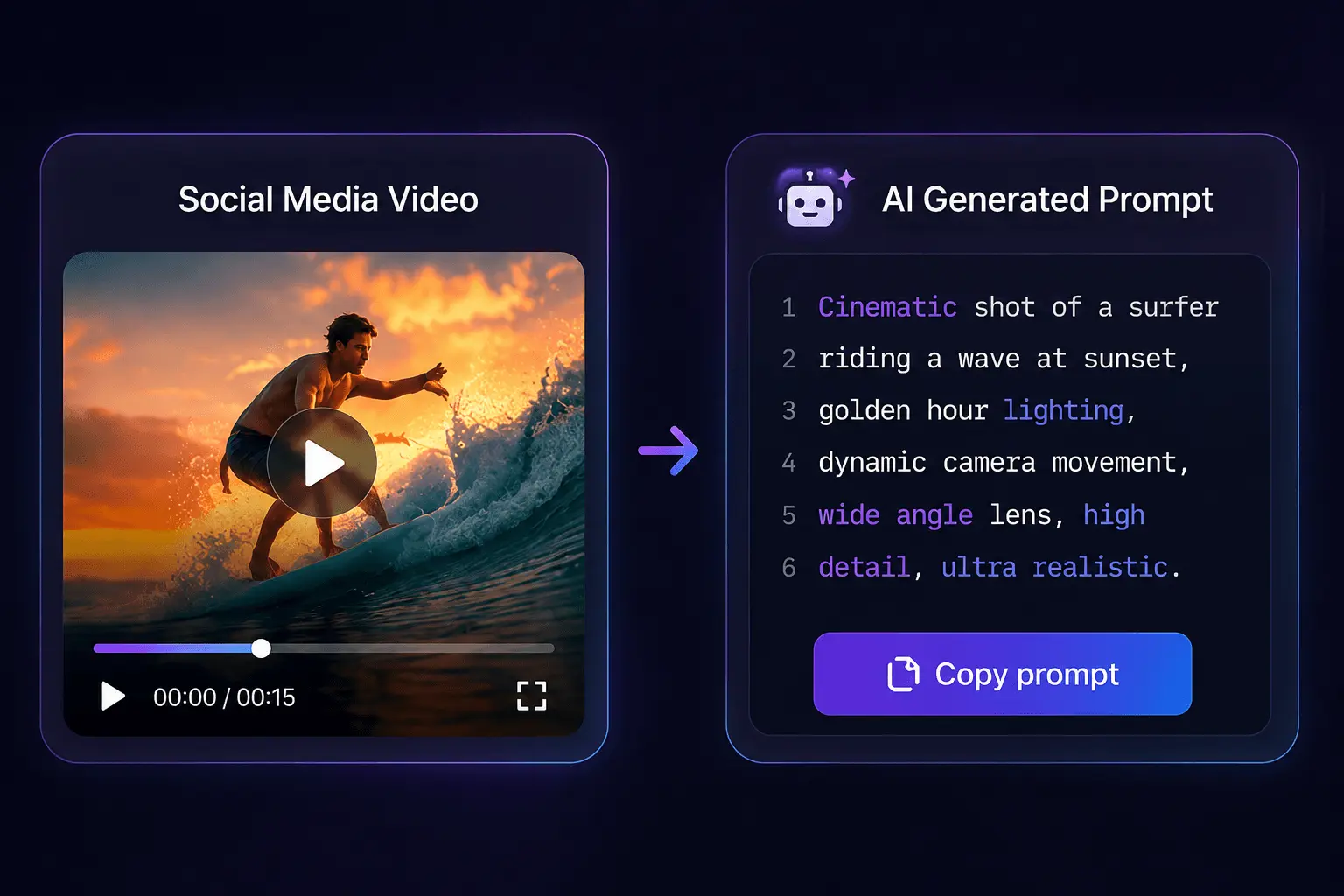
When the analysis stage runs, it extracts motion patterns, camera behavior, composition, lighting direction, and timing cues into a structured format. This is where a tool like SocialToPrompt enters the workflow — it handles the frame-by-frame extraction that manual note-taking cannot match, converting the visual density of the clip into a prompt structure ready for any AI video generator. The extraction stage alone saves the repetitive work of pausing, screenshotting, and transcribing visual details by hand.
The workflow spans 30+ supported platforms, and a typical 30-second clip produces a prompt from the extraction and analysis stages in well under a minute of processing. That speed changes how iteration works — instead of spending an evening writing one prompt from memory, a creator can run several clips through the same process and compare the resulting structures.
Local video files work as an alternative to platform URLs. Uploading an MP4, MOV, or WebM file directly bypasses platform restrictions and watermark issues, which matters when the reference clip came from a private message or a downloaded source. The same analysis pipeline runs regardless of whether the input arrived as a URL or a file upload.
The resulting prompt exports cleanly into common AI video generators. Veo, Kling, Runway, and Seedance all accept the structured format without significant modification, which removes the usual friction of reformatting prompts for each tool’s quirks.
Where Saree Prompts Usually Fail — and What a Writer Checks First
The most common failure mode is an imbalance between over-described detail that confuses the model and under-described cues that leave it guessing. Too many attributes crowd out the essential ones; too few let the model default to generic interpretations.
Fabric artifacts appear in predictable patterns: pattern-registration errors where the saree’s print misaligns across frames, stiff pleats that never move naturally, and pallu motion that looks like a flag rather than fabric responding to wind. These artifacts trace back to specific prompt elements — usually missing wind direction, absent fabric-weight descriptors, or conflicting environment cues.
Cultural accuracy problems surface differently. Wrong drape style or layer order reads as off even to non-specialist viewers, who sense that something about the garment does not look right without being able to name it. Fixing this means specifying the drape style explicitly rather than relying on the model’s default assumptions about Indian clothing.
Roughly three out of four failed generations could be traced back to missing or conflicting environment and lighting cues rather than to the subject description itself. The saree description was rarely the problem. The backdrop, the light source, and the atmospheric conditions carried more weight than most writers assumed.
One editor spent the better part of a week and roughly fifteen iterations trying to fix a saree scene. The fabric looked wrong, the motion felt off, the overall image read as synthetic. Every revision focused on the saree description — different fabric terms, adjusted drape phrasing, refined color specifications. Nothing worked. The actual defect was an unstated backdrop and lighting conflict: the prompt described golden-hour outdoor light while the setting implied an indoor reception hall. The model was trying to reconcile contradictory environment cues, and the fabric suffered as a result. Environment cues carry as much weight as subject cues.
A short diagnostic pass before running the generator again helps: check whether the lighting description matches the setting, whether the backdrop is specified or left to the model’s defaults, and whether the fabric behavior cues include wind direction and material weight. Community-shared prompt writing guidance reinforces this pattern — missing narrative context weakens the visual prompt in ways that subject-description tweaks cannot fix.
Two observations hold up across repeated iterations. Fabric print registration and pleat behavior matter more to a believable output than getting the drape style name exactly right — a model that renders pleats and print alignment convincingly reads as authentic even when the drape terminology is loose. And lighting temperature does more work than garment color in making a scene read as authentically filmed on location rather than studio-generated. A warm, slightly imperfect light source sells the scene; a perfectly saturated garment color does not.
FAQ
How much of the original clip does the AI actually need to produce a usable prompt?
A 10-to-15-second segment usually contains enough visual information for a detailed prompt, provided the segment includes the key moments — the pallu movement, the light shift, the subject’s turn. Longer clips add redundancy rather than new detail. A 30-second clip typically generates a prompt covering all essential attributes without the processing cost of a full-length video.
Can a prompt be generated from a saree video the reader no longer has the original file for?
Yes, if the video still exists on a public platform. A platform URL works as a source even when the local file is gone. If the clip was deleted or set to private, the prompt must be reconstructed from memory, which reintroduces the original problem of incomplete recall.
Which source platforms work best for pulling a clean saree reference clip?
Instagram Reels and Xiaohongshu carry the highest concentration of high-quality saree styling content with natural lighting and real fabric movement. YouTube offers longer, higher-resolution footage but skews toward tutorials rather than cinematic scenes. TikTok sits in between, with good variety but inconsistent quality.
Will a single structured prompt work across different AI video tools, or does each tool need its own format?
A well-structured prompt transfers across Veo, Kling, Runway, and Seedance with minimal adjustment. The core attributes — lighting, camera behavior, fabric movement, environment — translate directly. Each tool has its own syntax preferences, but the underlying descriptive structure remains compatible. Expect minor tweaks per tool, not a full rewrite.
What is the fastest way to fix a generation where the saree fabric looks stiff or wrong?
Check the environment and lighting cues first, not the fabric description. Stiff fabric usually means missing wind direction or an unspecified setting that conflicts with the light source. Add explicit fabric-weight language — “lightweight chiffon responding to a gentle breeze” — and verify the backdrop matches the lighting scenario before regenerating.
Share Article